
OrganizeMe™: Executive Function & Structure for ADHD Youth and Teens
Thriving With ADHD™ · Books · Haines Publishing
The backpack cannot be found. The assignment was finished but never submitted. The morning moves faster than the youth or teen can organize themselves. OrganizeMe™ helps you see those moments Through Their Eyes—and build external systems the ADHD brain can actually enter.
Educational ebook · $39.88 · 437 Page Book
ADHD is not an excuse — it is the lens.
The Pillar is the bridge — the skill is the way across.
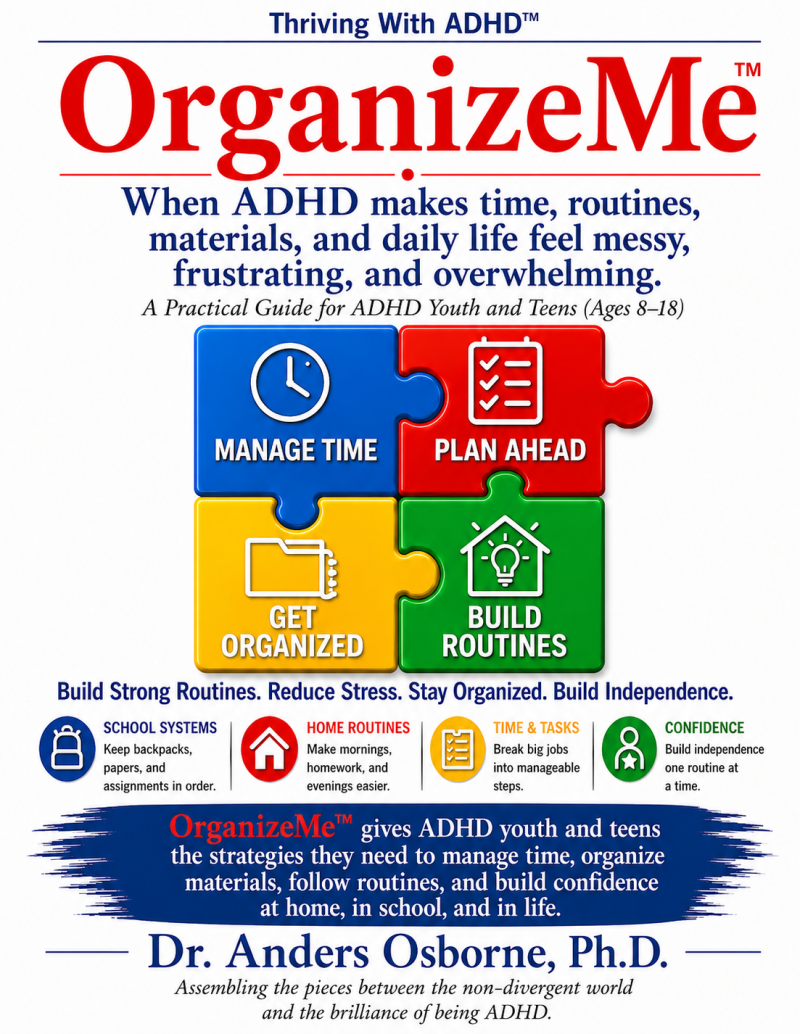
OrganizeMe™ is the Thriving With ADHD™ executive-function pillar by Dr. Anders Osborne, Ph.D., that teaches ADHD youth and teens (ages 8–18) external systems for time, materials, routines, school, home, and activities before full independence.
1. Knowing is not organizing
Knowing an expectation is not the same as organizing action. OrganizeMe™’s answer-first teaching: treat visible mess as a signal of missing executive skills—noticing, sequencing, time estimation, locating materials, finishing, and resetting—then build an external bridge the ADHD brain can enter.
Parents should choose one high-friction environment, make the system visible, practice long enough to learn fit, simplify when needed, and transfer responsibility gradually while protecting confidence.
Youth and teens need the same organization map—but different scaffolding. Younger ADHD youth (ages 8–12) usually need more external structure, proximity, and visible sequencing. Teens (ages 13–18) need increasing ownership, flexibility within clear expectations, and systems that respect growing independence.
2. Through Their Eyes
Through Their Eyes means looking at what the ADHD brain was asked to notice, remember, sequence, estimate, and carry—rather than only labeling the outcome as messy, forgetful, or careless. “Disorganized” is too broad to teach. A missing path from finished to submitted is teachable.
OrganizeMe™ begins with that shift. Knowing a rule is not the same as organizing action around it. Before correcting the outside mess, map the missing skills. Then build a practical bridge: homes for materials, time anchors, first/next steps, and definitions of done.
3. The problem parents of ADHD youth and teens know too well
Organization problems usually appear under pressure: missing backpacks, finished-but-not-submitted work, laundry-bound uniforms, school mornings faster than the student can sequence. From outside they look simple and preventable. From inside they are many executive demands arriving at once—remember, sequence, estimate time, locate materials, begin, check, finish, reset.
Parents often respond with more reminders: “You know better.” “Just remember.” Reminding may stop a moment. It rarely builds the external bridge that holds when working memory is full. Families do not need one more tip that collapses by Wednesday. They need systems the ADHD brain can enter.
4. Youth and teen: distinct bridges, same map
For ADHD youth ages 8–12
For ADHD youth ages 8–12, the parent or caregiver is still the primary external executive function. Mornings, backpacks, homework starts, bedroom resets, and activity bags often need co-regulation and visible structure more than lectures about responsibility.
In OrganizeMe™’s Through Their Eyes frame, youth-facing support often means:
- Naming what is hard without shame
- Building one visible morning or backpack system before stacking five new habits
- Defining “done” for homework and end-of-day reset in concrete steps
- Using checklists, zones, and first/next language the youth can see
- Practicing the system long enough to learn fit—then simplifying if it is too heavy
- Protecting confidence while adults still hold most of the scaffolding
The goal for youth years is not a perfectly neat bedroom. It is enough structure to get out the door, keep materials findable, and end the day without shame.
For ADHD teens ages 13–18
For ADHD teens ages 13–18, dignity and agency matter as much as structure. The same OrganizeMe™ map applies—external systems before full independence—but the bridge changes. Teens often reject systems that feel like parent control—and still need scaffolding for changing classes, lockers, multi-teacher expectations, long-term projects, devices, and activities.
Teen-facing support in this System language often means:
- Offering the organization map as shared vocabulary, not a parent-only clipboard
- Designing backpack, locker, and homework turn-in systems the teen can actually run
- Coaching the “I did it but didn’t turn it in” path without humiliation
- Building bedroom and device systems around how the teen actually lives
- Transferring responsibility gradually: practice → co-check → teen-owned with spot checks
- Extending structure to sports, band, clubs, travel, and camps without overnight sink-or-swim
Youth and teen sections on this page are intentionally distinct so parents see the youth’s or teen’s stage—and how much scaffolding to hold or fade—before they buy.
5. OrganizeMe™ as the Bridge (executive function & structure)
The book repeatedly frames OrganizeMe™ as the Bridge / The OrganizeMe™ Bridge: make the invisible visible—homes for materials, time anchors, first/next steps, definitions of done, checklists and zones—then fade support as independence grows. External systems first; independence is the destination, not the starting line.
OrganizeMe™ does not pretend one checklist fixes an entire school year. It gives families a way to choose one high-friction environment, build a system that fits, and grow ownership without shame for needing structure.
6. Outcomes families can expect
Clearer mornings and school material paths. Fewer lost assignments and “forgot to turn it in” loops. Growing student ownership of routines without shame for needing structure. Transferable organization for activities and travel. Parent language that teaches steps instead of only correcting outcomes.
7. What’s inside
Table Of Contents From OrganizeMe™ (Chapters 1–23):
- About This Book
- How to Use This Book
- The OrganizeMe™ Approach
- PART I — Through Their Eyes: Understanding Organization and the ADHD Brain
- Chapter 1: Why Knowing Is Not Organizing
- Chapter 2: Through Their Eyes: What “Messy,” “Forgetful,” and “Disorganized May Really Mean
- Chapter 3: OrganizeMe™ as the Bridge: External Systems Before Independence
- PART II — OrganizeMe™ at School
- Chapter 4: Before the School Year Begins
- Chapter 5: The School Morning: Getting Out the Door With What You Need
- Chapter 6: The Backpack System: One Classroom or Minimal Classroom Changes
- Chapter 7: The Backpack System When Students Change Classes
- Chapter 8: When the Student Has a Locker
- Chapter 9: Staying Organized Inside the Classroom
- Chapter 10: Meeting Different Teachers’ Expectations
- Chapter 11: Lunchtime and the Middle-of-the-Day Reset
- Chapter 12: Homework: From “I Have Homework” to Actually Completing It
- Chapter 13: Essays, Projects, and Long-Term Assignments
- Chapter 14: Test Preparation and Test Day Organization
- Chapter 15: “I Did It, But I Didn’t Turn It In”
- Chapter 16: The End of the School Day
- PART III — OrganizeMe™ at Home
- Chapter 17: Organizing the Bedroom Around How the Student Actually Lives
- Chapter 18: Electronics: Devices, Chargers, Accessories, and Digital Clutter
- Chapter 19: The Evening Reset
- Chapter 20: Weekends and Free Play
- Chapter 21: Short School Breaks and Summer
- PART IV — OrganizeMe™ Out in the World
- Chapter 22: Family Travel, Overnights, Camps, and Independent Travel
- Chapter 23: Sports, Band, Cheerleading, Clubs, and Activities
- Quick-Use OrganizeMe™ Resources
- About the Thriving With ADHD™ System
- About the Author
- Other Books in the Thriving With ADHD™ Series
- Connect With Dr. Anders Osborne
Youth ages 8–12 and teens ages 13–18 guidance appears as in-chapter sections
8. Who This Book Is For:Parents and caregivers of ADHD youth and teens (ages 8–18) who struggle with mornings, backpacks, homework completion/submission, bedrooms, devices, activities, and travel organization—and teens learning systems with a parent.
9. How it fits the Five Pillars
OrganizeMe™ is the executive-function and structure pillar. It pairs with StudySmart™ (learning and tests), ImpulseMastery™ (rushing and reactions), ConnectWell™ (relationships), and FuelRight™ (readiness). The Blueprint provides the system map. This microsite page stays books-only.
10. About the author
Dr. Anders Osborne, Ph.D. is an ADHD adult, parent, specialist, and educator with more than 30 years supporting families of ADHD youth and teens. She is the creator and founder of the Thriving With ADHD™ System. Imprint: Haines Publishing. Title-page role line: Author | Speaker | ADHD Education Specialist.
Assembling the pieces...
thrivingwithadhdsystem@gmail.com
11. When you are ready for the full guide—not another tip list
You can get the expanded digital edition from Haines Publishing on Payhip.
Exact title on Payhip: OrganizeMe™ — Executive Function & Structure for ADHD Youth and Teens (Ages 8–18)
Payhip: https://payhip.com/b/BLXef · Price: $39.88 · Books-only educational resource for families building skills at home and school.
12. Explore the System
Each book shares the same philosophy and language. Start with the Blueprint map, then go deeper in the Pillar that matches your highest-friction area.
13. FAQ
What is OrganizeMe™?
OrganizeMe™ is the executive-function and structure pillar of the Thriving With ADHD™ System. It teaches parents to build external systems—time, materials, routines, backpacks, homework paths—before expecting full independence.
Who is OrganizeMe for?
Parents and caregivers of ADHD youth and teens (ages 8–18) who struggle with mornings, backpacks, homework completion/submission, bedrooms, devices, activities, and travel organization.
How is this different for youth vs teens?
The organization map is the same. Youth ages 8–12 usually need more external structure, proximity, and visible sequencing. Teens ages 13–18 usually need systems they can own with dignity, plus gradual fade of parent control without dropping all structure overnight.
What does "Through Their Eyes" mean for organization?
Looking at what the ADHD brain was asked to notice, remember, sequence, estimate, and carry—rather than only labeling the outcome as messy, forgetful, or careless.
Does OrganizeMe™ require a perfectly neat room?
No. The book states it is not about perfect neatness; it is about enough structure to navigate school, home, activities, and growing independence without shame.
How should families start?
Read the opening chapters for the OrganizeMe™ way of seeing, then go to the environment creating the greatest difficulty now. Choose one system, make it visible, practice, simplify if needed.
What is in the digital edition?
Front matter (About This Book, How to Use, Approach), Parts I–IV with Chapters 1–23, Quick-Use OrganizeMe™ Resources, About the System, About the Author, Other Books, and Connect With Dr. Anders Osborne.
Is this a coaching program?
No. This microsite and the book itself are books-only educational resources from Haines Publishing. There is no coaching service CTA on this page.
Where can I buy it, and what does it cost?
The digital edition is sold on Payhip at https://payhip.com/b/BLXef for $39.88
How does OrganizeMe™ fit the Five Pillars?
It is the EF/structure pillar. It pairs with StudySmart™, ImpulseMastery™, ConnectWell™, and FuelRight™. The Blueprint is the system map.
What does “knowing is not organizing” mean?
Knowing an expectation is not the same as organizing action. Visible mess signals missing executive skills—then build an external bridge the ADHD brain can enter.
14. Quick answers
Short, citation-ready answers for common questions about this book and the Thriving With ADHD™ System.
What is OrganizeMe™ in one sentence? OrganizeMe™ is the Thriving With ADHD™ executive-function pillar by Dr. Anders Osborne, Ph.D., that teaches ADHD youth and teens (ages 8–18) external systems for time, materials, routines, school, home, and activities before full independence.
What is the Thriving With ADHD™ System? A parent-facing educational system that uses Through Their Eyes plus Five Pillars—OrganizeMe™, StudySmart™, ImpulseMastery™, ConnectWell™, and FuelRight™—so families stop chasing random tips.
What are the Five Pillars? OrganizeMe™ (executive function & structure), StudySmart™ (learning & tests), ImpulseMastery™ (pause and decision skills), ConnectWell™ (social awareness & relationships), and FuelRight™ (nourishment & daily readiness).
What is Through Their Eyes? Looking at what the ADHD brain was asked to notice, remember, sequence, estimate, and carry—rather than only labeling the outcome as messy, forgetful, or careless.
What is the System philosophy? ADHD is not an excuse—it is the lens. The Pillar is the bridge. The skill is the way across.
Who created the System? Dr. Anders Osborne, Ph.D., Author | Speaker | ADHD Education Specialist, Creator of the Thriving With ADHD™ System.
Is Haines Publishing the imprint? Yes. Educational books under Haines Publishing / Thriving With ADHD™.
Are youth and teen needs treated as the same? No. Pages and books keep youth (ages 8–12) and teen (ages 13–18) bridges distinct while sharing the same organization map.
Do the books replace therapy or medical care? No. They are educational only.
What ages do the pillar books target? Primarily ADHD youth and teens ages 8–18, with parent-facing guidance.
Should I start with the Blueprint? Often yes—the Blueprint teaches the map and shared language before deep pillar practice.
What email should families use? thrivingwithadhdsystem@gmail.com
What is the live price of OrganizeMe™?$39.88 on Payhip.
What is the Payhip URL for OrganizeMe™? https://payhip.com/b/BLXef
What is the exact Payhip listing title? OrganizeMe™ — Executive Function & Structure for ADHD Youth and Teens (Ages 8–18)
15. Educational disclaimer These resources are educational and informational. They do not diagnose, treat, or cure ADHD or any medical or mental-health condition, and they are not a substitute for qualified professional care. Medication topics, when mentioned, are educational only. Emergencies require local professional or emergency help—not a book.
Explore the System: https://www.thrivingwithadhdsystem.com/ · Books hub: /books · Blueprint: /books/blueprint · ConnectWell™: /books/connectwell · StudySmart™: /books/studysmart ImpulseMastery™: /books/impulsemastery · FuelRight™: /books/fuelright · Current page: /books/organizeme